Monday, June 21, 2010

Mrs. Charlene Schiff


Mrs. Charlene Schiff was born in 1929, and her hometown of Horochow, Poland was taken over by Nazis and turned into a ghetto. She is one of the few survivors of the ghetto. If she didn't survive, we would not have had the pleasure of listening to her story. When Mrs. Schiff escaped from her ghetto, and she was supposed to go live with a man on his farm. She escaped with her mother and sister. She hid in a river with her mother while the ghetto was being wiped out. She dozed off and when she woke up, her mother was gone. When Mrs. Schiff got to the farmer who was supposed to take care of her, the farmer only allowed her to stay for a night and after that, he would call the Nazis. Schiff ran from forest to forest hiding from the Nazis until the Soviet army found her dying in a forest and took care of her.

Mrs. Schiff is now a speaker with the holocaust museum and she fights the four evil I's (indifference, intolerance, ignorance, and injustice), and she enjoys retelling her stories and tales from the ghetto and the holocaust.


Holocaust Pictures

HOLOCAUSTHere are some pictures from the Holocaust
The Holocaust was the KILLING of Jews and other European civilians. It is also the Nazis' systematic murder of MILLIONS of people in groups, including Romani, Ethnic Poles, Soviet civilians, people with disabilities, Soviet prisoners of war, homosexuals, Jehovah's witness, and other political and religious opponents. The total number of the Holocaust victims would be between 11 million and 17 million people.
The Holocaust ended in SPECIFIC places when the Allies freed the camps near the end of the war. It officially ended at the end of WWII and when all the German troops surrendured.


Daily Routine at a Ghetto


Mrs. Charlene Schiff lived in a ghetto in Horochow for a long time until she escaped with her mother, who she never saw again. Mrs. Schiff's town was taken by the Nazi's in 1941 when she was very young. Her hometown of Horochow was turned into a ghetto. Living in a ghetto was not as bad as a death camp, but it was still a terrible place.

In a ghetto people where forced to live in terrible living conditions, with very little resources needed to survive. Here are some hardships Mrs. Schiff and other Jews living in ghettos encountered.

  • Seeing people killed by guards and officers of the ghetto
  • Children had to smuggle food into the ghetto to feed their families, and if they did not survive, their families starved to death in the ghetto
  • People were treated cruelly and like animals, they were tortured and starved, even killed. Some unlucky people where even killed for strange reasons.
Mrs. Schiff escaped the ghetto, and she was to go to a farmers house to live with him, so she escaped with her mother and sister, and she hid in a river. She fell asleep for a while and when she awoke, her mother was gone. She went in search of her mother, but she was never found. Fortunately, Mrs. Schiff is still alive today.

The Auschwitz Death camp


This video is in honor of the survivors of the World War II era and to thank all the veterans and civilians who came to share their amazing stories at Rocky Run.


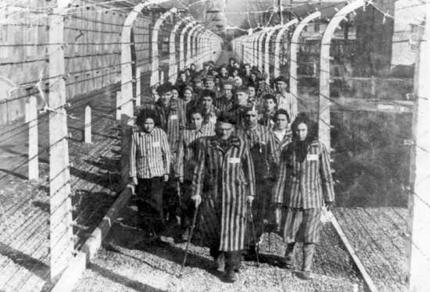
This is the Auschwitz Death camp where Rabbi Berkowits was captive

This is a picture of the prisoners being released from the Death Camp.

The Auschwitz death camp had about 1.1 million casualties by the end of the war.


This is the chamber the Nazis would kill Jews and Prisoners of War by filling the chamber up with gas.


Here are scratch marks on the wall of the gas chamber from the prisoners trying to escape.

Daily Routine at a Labor Camp

There were many Nazi Labor Camps, but one of the most famous ones, was Auschwitz. Rabbi Laszlo Berkowits was taken to Auschwitz when he was only 16, in 1944. He was released in 1945, and later became a rabbi.

A typical day at a Labor camp is as follows:
  • Waking up at about 4 am for morning roll call and breakfast, which consisted of about 10 oz of bread.
  • Going off to work upon the guards request
  • Working usually meant 12-14 hours of long, useless tasks such as digging large holes or trenches, carrying heavy sandbags from one place to another or even carrying bricks and stones from one place to another
  • Guards will whistle for lunch break which consists of a small meal of small portions. Lunch breaks were usually short and some people didn't even get to eat
  • After lunch break, they would return to work, completing tedious jobs, they were working the people to death
  • At the end of the day, there is another roll call, and you go to eat another measly meal for dinner, and then the lucky people remaining who have not died will get to go to bed.

As you can tell, a day at a Labor Camp was not easy. Guards would try and work people to death.

Train Ride To Auschwitz

This video is an excellent reenactment of the average prisoner's arrival at Auschwitz-Birkenau, from the film The Last Train to Auschwitz. Rabbi Berkowitz went through about the same experience.

Common Treatment of Arrivals:

  • The separation of men and women- Women were often gassed on arrival
  • The yelling and beating of the prisoners
  • Packed tightly onto train car
  • Spoken to in one language, no matter if they could understand

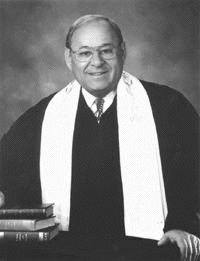
Rabbi Laszlo Berkowits


Rabbi Lazlo Berkowits was born in Hungary when he was 16 years old the Nazis took him to the Auschwitz death camp. He was moved to different concentration camps. He was tortured by useless labor for a year before being liberated by the 101st Airborne of the United States. After his liberation, Rabbi Berkowits lived briefly in Sweden before moving to the United States to study to become a Rabbi. Rabbi Berkowits became a Rabbi in 1962.